
Bringing Reminders into WhatsApp
I kept using unread messages, starred messages and screenshots to remember things I had to do later. I wanted to see whether WhatsApp could make coming back to an important message a little easier.
The project at a glance
- Problem
- People receive WhatsApp messages that require action later, but existing workarounds don't reliably bring them back at the right time.
- Approach
- An initial survey, investigation of existing workarounds, problem definition and product exploration.
- Proposed solution
- A reminder attached to an individual message, with scheduled notifications and a separate Reminders inbox.
- Work produced
- Product case study, high-fidelity Android prototype and detailed PRD.
- Key trade-off
- Reminders on individual messages, rather than expanding into a general task manager or shared group tasks.
- Status
- Independent product concept. Not shipped.
The idea
A message arrives while you're busy. You read it, tell yourself you'll come back to it, and move on. A few hours later, you might not remember it at all.
Direct observation
I kept running into this with WhatsApp. I would leave messages unread, star them, pin them, take screenshots or forward them to myself. These methods helped me keep a message somewhere, but none reliably brought it back to my attention at the time I needed it.
I wanted to explore a simple question: what if you could remind yourself about an individual WhatsApp message, without taking it out of the conversation?
First, was this actually a problem?
Survey findings
I began with a short questionnaire shared with 36 friends and colleagues aged 21–28 who use WhatsApp frequently. This was a convenience sample, not a representative study of WhatsApp users, so I treated it as an initial signal.
A few findings stood out:
91.7% had forgotten or significantly delayed a follow-up in the previous 30 days.
80.6% said they leave messages unread when they cannot act on them immediately.
75% receive messages requiring later action several times a week.
58.3% identified distraction from other messages or tasks as a reason for missing follow-ups.
The findings gave me a reason to explore the problem further, but they did not prove that people would adopt a new feature.
Narrowing the problem
My first idea was much broader: shared Tasks for WhatsApp groups. But that introduced questions around ownership, assignments, responsibility and completion.
I stepped back and returned to the original behaviour. One person receives one message, cannot act on it immediately and needs to return to it later.
That became the focus: a reminder attached to an individual message, with the original conversation context preserved.
The proposed experience
The concept has two connected parts:
Create a reminder from a message. Long-press a message, select the reminder action and choose a date and time.
Return to it later. Receive a notification when it is due, or find it in a dedicated Reminders inbox.
The inbox is important because a notification can arrive at an inconvenient moment. Dismissing it should not mean losing the reminder. Each entry retains the sender, conversation, message preview and scheduled time, and can take the user back to the original message.
Decisions that shaped the first version
I deliberately kept the experience narrower than a full task manager.
One active reminder per message. Setting another replaces the existing schedule.
A single date-and-time picker with date, hour and minute rollers.
A dedicated inbox for active reminders across conversations.
Users can open the original message, reschedule or delete a reminder.
No Done button, snooze or completed-reminder archive in the first version.
Notification behaviour respects device and chat settings, while reminders remain accessible in the inbox where possible.
Message availability, disappearing messages, archived chats, locked chats and device restarts are accounted for in the requirements.
These boundaries were intended to keep the feature focused on helping people return to messages, rather than creating another place to manage their lives.
What I left out of V1
There were several things I considered but deliberately didn't include in the first version. The aim was to make the individual-message reminder experience work well before expanding it into something bigger.
There is no general-purpose task manager. The feature is meant to help people return to messages rather than become another place to manage their lives, and it isn't meant to replace a full task-management app.
There is no group task assignment. My first idea was shared Tasks for WhatsApp groups, but it raised questions about ownership, assignments, responsibility and completion, and it moved away from the behaviour I started with: one person, one message, and a need to come back to it later.
There is no Done state. Deleting a reminder means it is no longer needed, not that the task is done, and V1 doesn't try to infer completion. The success metric only asks whether people return to the original message.
There is no Snooze action. It would add another task state to manage. An overdue reminder can be rescheduled from the same picker instead, by tapping its alarm indicator.
There is no completed-task history. Without a Done state there is nothing for a history to record, and keeping one would push the feature towards being a completion tracker, which V1 deliberately is not.
How I would evaluate it
I proposed Reminder Follow-through Rate as the primary success metric: the percentage of eligible reminders that lead to the original source message being opened within 24 hours after the scheduled time.
Opening a notification or the inbox alone does not count. The user needs to return to the original message.
Assumption
I also proposed two decision thresholds, T1 and T2, to guide what happens after a pilot. The 20% and 40% thresholds are hypotheses for evaluation, not established benchmarks or results from a live test.
Supporting measures would include discovery, repeat usage, rescheduling, overdue reminders and notification opt-outs. Reliability, privacy and notification behaviour would remain guardrails.
What I'd validate next
These are the questions I'd want answered before treating the proposal as ready to build.
Do people understand how to create a reminder from a message?
Do scheduled reminders bring people back to the original message?
Does the separate inbox help people keep track of reminders?
Does the feature create unnecessary notifications or another inbox people feel obliged to check?
Do people continue using it after the first few reminders?
What comes out of this project
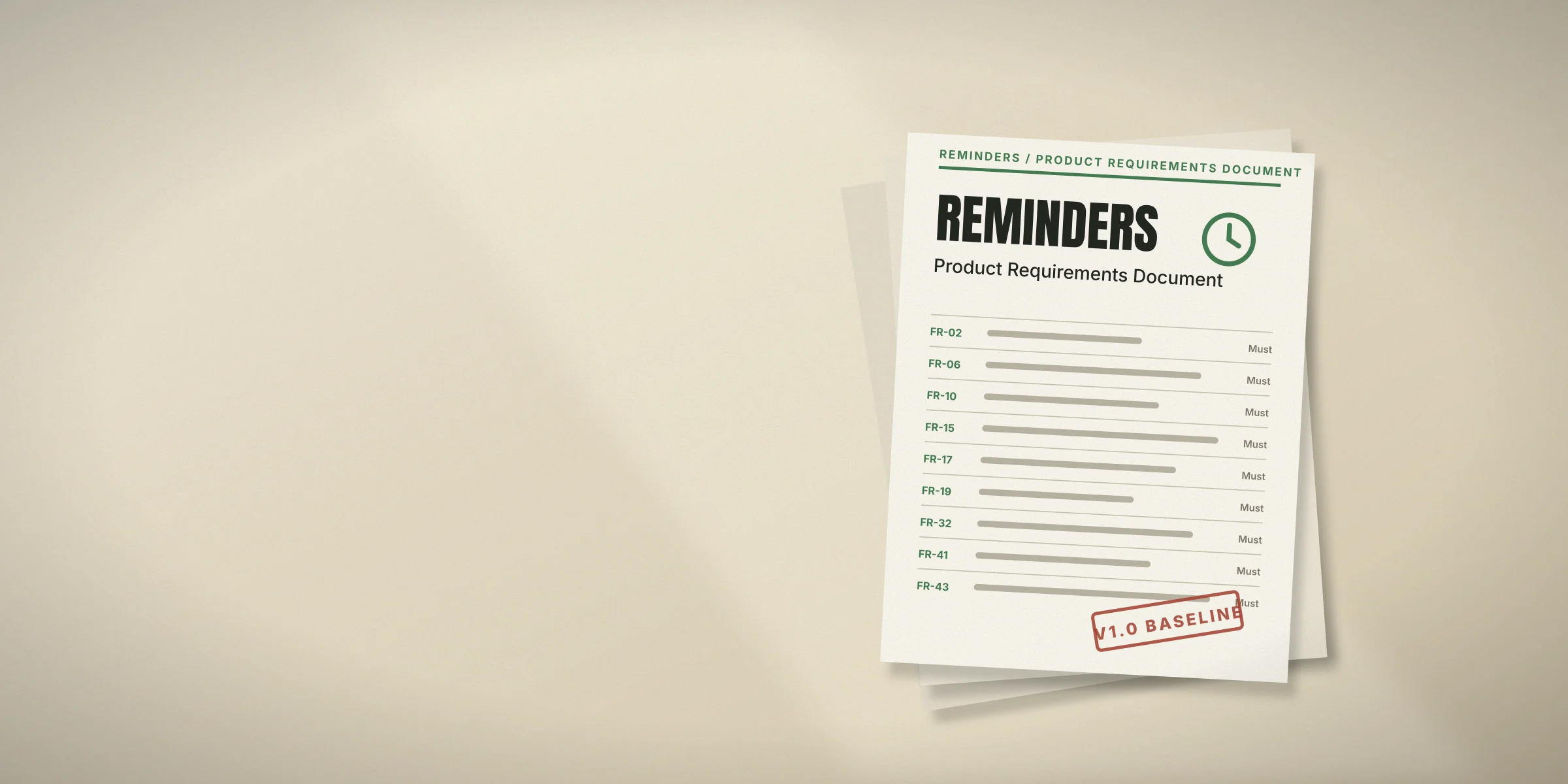
I took this concept from problem discovery through product definition and interaction design. The work includes a high-fidelity Android prototype, a Product Requirements Document, edge-case requirements, a measurement framework and a proposed phased rollout.
It has not been shipped or tested in a live product pilot. The research is an initial signal, and the success thresholds remain hypotheses.
The central idea is quite small: when a message arrives at the wrong time, WhatsApp should give you a reliable way to come back to it at the right time, without losing the conversation around it.
Project resources
Medium article: Bringing Reminders into WhatsApp
Product Requirements Document: read it on JD TV or download the PDF.
Figma prototype: available on request. Email me, and I'll send you the link.
This is an independent portfolio project. It was developed without involvement from WhatsApp or Meta and is not affiliated with, commissioned by or endorsed by either company.