
Failed. Debited. Now What?
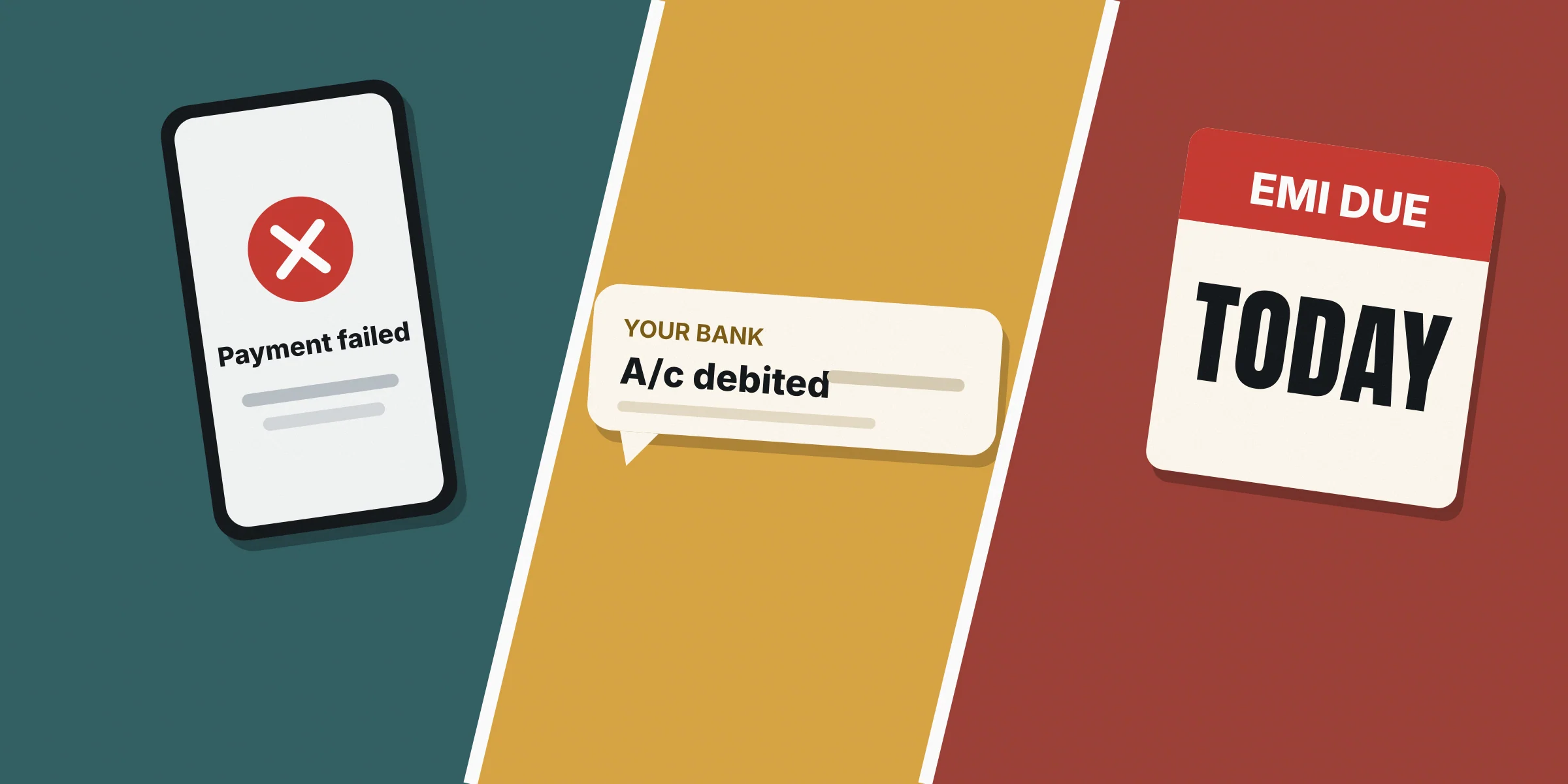
The app says the payment failed, the bank says the money is gone, and an EMI is due today. This PRD looks at how a UPI app could explain what happened and what the user should do next.
The project at a glance
- Problem
- A UPI transaction can fail while the user's bank account has already been debited. The user needs to know what happened, what happens to the money and what to do next.
- Approach
- Investigate the failed-transaction experience, applicable reversal expectations and the information users need during the resolution process.
- Proposed solution
- A clearer transaction-status experience with an explanation of the payment state and an expected resolution timeline.
- Work produced
- Product requirements document and proposed user experience.
- Status
- Independent product concept. Not shipped.
Problem statement
When a UPI payment fails after the payer's account has been debited, the UPI app usually says Failed while the bank says the money has left. The user is left holding two screens that contradict each other, no timeline they trust and no obvious next step. The money normally comes back. The problem is the uncertainty, and the decisions people make while they wait.
Evidence
Community discussion
Between Oct 2026 and Nov 2026, on r/UPI, a community of roughly 34,000 members, I found five independent posts describing this situation. A sixth was the same person cross-posting, so I counted it once. The three I read in full had between 2 and 11 upvotes each, so this is a pattern in a handful of stories, not a measure of how often it happens.
A payer sent ₹5,999 through Union Ease and saw the error "Risk threshold exceeded" while the money was deducted. The bank's grievance portal then displayed "Ticket ID #undefined was successfully submitted" and the complaint never appeared in their list. The refund arrived within 48 hours.
A BHIM user saw Failed while SBI showed the debit, and asked whether this was normal or needed a complaint. They emailed both BHIM and SBI, and were refunded within 24 hours.
A payer whose bank app showed the payment as debited and successful, while the UPI app showed it as failed, had an EMI due that day and no other funds. The next day they wrote: "Intrest is charged and no refund has come."
One user describes a payment shown as failed in the app, which support later said had succeeded, after they had already paid again.
Another post simply asks other members what happened when their payment failed but was deducted. I only read its title, but the fact that it reads like a recurring question says something on its own.
What people are told
Community discussion
Across just two small threads, commenters offered five different timelines: "within 24hrs", "1-3 days", "atleast 72 hours", "2-3 business days" and "within 96 hours". None of them cited anything. One also warned that a reversal sometimes arrives with no message and no entry in the transaction history, so people may not even notice it has happened.
There is, in fact, a rule. The RBI's 2019 circular on turnaround times for failed transactions says that for a UPI fund transfer where the payer is debited but the beneficiary is not credited, the reversal is due by T+1, and the bank owes ₹100 per day of delay after that. For a merchant payment where the confirmation never reached the merchant, reversal is due within T+5, with the same ₹100 per day afterwards. Compensation has to be credited without the customer having to ask, and anyone not helped in time can escalate to the RBI's Integrated Ombudsman Scheme. The rule protects users. Almost nobody in these threads seemed to know it existed.
What people do instead
They email the app and the bank, and wait.
They pay again, which is reasonable under a deadline and also how people end up paying twice.
Under a deadline, one commenter suggested loading a wallet with a credit card and transferring the money, at a convenience fee of around 2 to 2.5 percent, to make the EMI on time.
After the late charge landed, another suggested paying immediately and then emailing the bank with the screenshot to ask for a waiver.
Some help already exists. In BHIM, one commenter explained, the transaction history has a UPI Help option with a category called "Account debited but transaction confirmation not received at merchant location". It is a sensible feature. The user found it through a Reddit comment.
Where I disagree with Reddit
The most common advice, that you will get the money back, is mostly right, and the evidence leans that way: two of the three posters who followed up were refunded within 48 hours. The third had not been refunded by the next day and had already been charged interest, which is the case this PRD exists for. So the main problem is not missing money. It is a day or two of not knowing, and the damage that uncertainty does when there is a deadline attached. The other popular advice, to move to a different bank, is not a product fix. These failures appear across banks and apps in the posts I read.
Users
The primary user is a payer under time pressure: an EMI, rent, or a merchant waiting at the counter.
A second primary user is a payer with a low balance, for whom a stuck debit means they cannot simply pay again.
The recipient is a secondary user who sees nothing at all, and has to take the payer's word for it.
Goals and non-goals
The goals are to tell the user the true state of their money, show the official timeline in plain language, make the next action obvious, and reduce accidental double payments.
The non-goals are changing UPI switching or settlement, speeding up reversals, which is bank operations, and building a new grievance system. This PRD is about the layer the user can see.
Proposed solution
1. Stop saying Failed when money may have moved
Reserve Failed for cases where the app is confident no money left the account. When the debit may have happened, or the response is uncertain, show a distinct status: Money debited, payment not completed. Failed tells the user that nothing happened, which is not true when money has left their account.
2. A reversal tracker on the transaction
The transaction screen shows a short timeline: when the debit happened, the date the reversal is due under the RBI rule for that type of payment, the date after which compensation of ₹100 per day applies, and, once it lands, when the money came back. This turns five folk timelines into one official one.
3. An honest next step
Below the tracker, one line of guidance: if the payment is not urgent, wait for the reversal before paying again. If it is urgent, the user can pay again, and the app says plainly that the first amount will still be returned. That is better than either silence or a blanket "do not retry", which ignores the person whose EMI is due today.
4. A dispute that actually exists
One tap raises a dispute pre-filled with the transaction reference, and returns a real reference number that appears in the app straight away. If the ticket cannot be created, the app says so instead of announcing that ticket #undefined was successfully submitted.
5. A reversal that announces itself
When the money comes back, the user gets a notification linked to the original transaction, and the transaction's status changes to Reversed. Money should not quietly reappear in a balance.
6. Proof of the attempt
A downloadable, timestamped record of the attempted payment, so a borrower can send it to a lender when asking for a late fee to be waived. Reddit users are already doing this with screenshots; the app can make it cleaner and more credible.
Requirements
ID | Requirement | Priority |
|---|---|---|
R1 | Distinct status for debited but not completed payments, separate from Failed | Must |
R2 | Reversal tracker showing due date and compensation date by payment type | Must |
R3 | Retry guidance that distinguishes urgent from non-urgent payments | Must |
R4 | Pre-filled dispute with a visible, valid reference number | Must |
R5 | Reversal notification linked to the original transaction | Should |
R6 | Downloadable proof of attempted payment | Could |
Proposed success metrics
These are proposed metrics for an A/B test or a staged rollout. None of them are results.
Proposed metric | Direction |
|---|---|
Repeat payments to the same payee within 30 minutes of a debited but not completed transaction, where the first is later reversed | Down |
Support contacts per debited but not completed transaction | Down |
Disputes raised with a valid reference, as a share of all disputes raised | Up |
Reversals followed by a notification the user opened | Up |
Transactions shown as debited but not completed where no debit actually happened | Guardrail, as close to zero as possible |
Risks and open questions
The UPI app may not always know whether the debit happened. The status depends on a reliable signal from the bank side, and the copy has to be honest when the signal is uncertain.
Showing compensation dates will lead more people to claim compensation. That is the point of the rule, but banks may not welcome it.
Telling people they may pay again under urgency risks more double debits in the short term. The tracker and clear reversal messaging are what make that acceptable.
The legal wording of any statement about RBI timelines would need review by people qualified to give it.
What I'd validate next
These are the questions I'd want answered before treating the proposal as ready to build.
Can the app tell reliably enough when money has left the account, so that Money debited, payment not completed only appears when it is true?
When people can see the date a reversal is due, do they wait instead of paying again?
Does the guidance for urgent payments reduce accidental double payments, or add to them?
Do people understand the reversal and compensation timeline, and is the wording accurate enough to pass legal review?
Do disputes with a visible reference number lead to fewer repeat support contacts?